Site Owners
Pilots
Download our app below to start discovering new landing sites




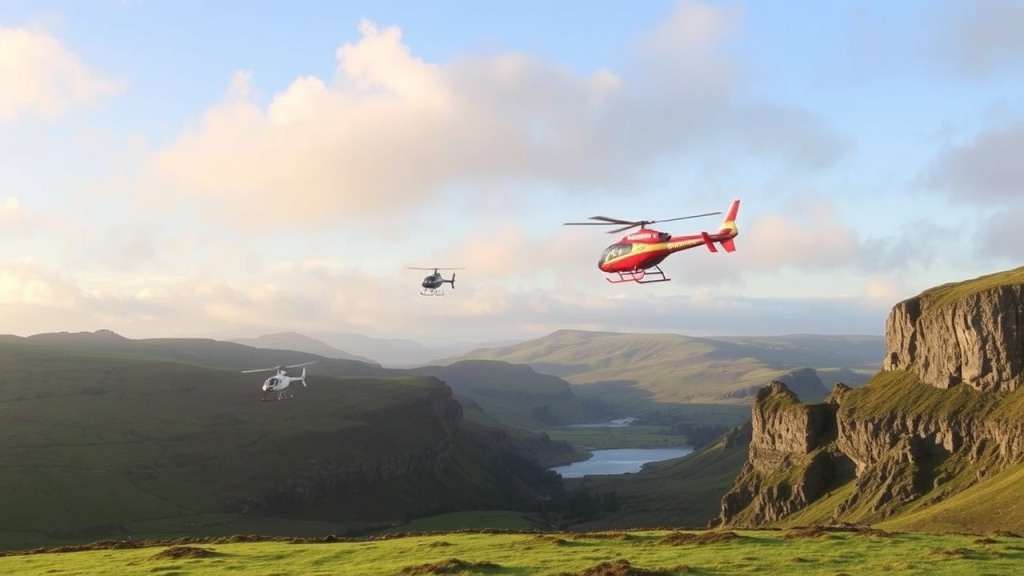
Updated July 2026 after a Helipaddy tour of southern Ireland.
Ireland is an excellent helicopter-touring country, but the practical reality is rather different from the impression given by a chart or airport directory. The sea crossing was easier than expected, the country is compact, fuel needs disproportionate planning, and the collapse in private helicopter activity means that hotel landing arrangements vary enormously.
This is our first-hand account, not a substitute for the current AIP, NOTAMs, weather, GAR requirements or specific PPR.
We used the two obvious corridors: Haverfordwest to Waterford in the south, and the route between the Aberdaron end of the Llŷn Peninsula and Dublin farther north. In good conditions neither felt especially demanding.
The administrative side was also less intrusive than expected. We did not need an intermediate airport stop simply to clear customs or immigration, and nobody met us on arrival. That does not mean there is no paperwork or that every private site is eligible: the actual departure and arrival locations must be authorised for the route, UK GAR reporting still applies to UK–Republic of Ireland flights, and Irish destinations may require crew and passenger details in advance. Kilrush, for example, publishes its own customs notification instructions.
Distances that look significant on the map are surprisingly manageable in the air. In our aircraft, crossing the country was roughly an hour and a half. That makes a multi-stop tour practical and gives plenty of flexibility when weather or a landing permission changes.
The trap is to confuse short sectors with easy logistics. Fuel availability, rather than distance, is likely to define the route.
Refuelling was the most difficult part of the trip. Many of the larger airports are council-run and, in our experience, showed little interest in making a small general-aviation helicopter movement simple. Published fuel availability does not necessarily mean a quick or economical uplift.
Kilrush (EIKH) was the clear exception. It welcomed helicopters, had both Avgas and Jet A1, and the self-service arrangement made the stop exceptionally easy. We would build an Irish tour around Kilrush unless another uplift had been firmly confirmed in advance.
Among the larger airports, Shannon was the best of a poor set of options. Jet A1 is available, but the Irish AIP says prior notice is required if you do not have standing arrangements. Ask clearly whether handling is actually mandatory and decline optional handling if you do not need it; otherwise the cost and delay can overwhelm a simple fuel stop.
International VFR flights require a full flight plan. AirNav accepts an air-filed flight plan when no other means of submission is practicable, but the aircraft may have to remain clear of controlled airspace while it is processed. If departing internationally from an aerodrome outside controlled airspace, advise the appropriate ATS unit of the departure—by telephone beforehand or by radio after take-off—so the departure message can be distributed.
Do not confuse that full international flight plan with the abbreviated details that may be passed by radio solely to cross controlled airspace. The abbreviated plan lasts only for that controlled-airspace crossing.
In practice, the airspace itself feels familiar. Obtain clearance before entering controlled airspace. In Class G, a VFR flight does not need an ATC clearance or continuous conversation merely to continue through Class G, although radio mandatory zones, aerodrome procedures and other published requirements still apply. Flight information and alerting services remain available if wanted.
Private helicopter activity in Ireland appears to have collapsed. We were told that fewer than a dozen privately used helicopters remain in the country, and that scarcity shows in the uneven response from hotels and estates.
Some venues are relaxed and helpful; others have little recent experience and may be cautious, confused or simply uninterested. Treat every hotel landing as a fresh permission exercise. Confirm the exact landing area, obstacles, livestock, neighbours, arrival time and who will meet the aircraft. A good-looking lawn and an old photograph of a helicopter are not enough.
Use Helipaddy to shortlist possible landing sites and review recent pilot information, then contact the venue directly before relying on it. The Dublin city guide is also a useful starting point for sites around the capital.
Northern Ireland is part of the UK aviation system. Use the UK CAA and NATS AIP, not the Irish AIP, for airspace, aerodromes and procedures north of the border. A tour that includes both jurisdictions therefore changes regulatory systems even though the land border is invisible from the air.
For a private, non-reward flight, the practical differences are:
| Route, either direction | What the pilot needs to do |
|---|---|
| Great Britain–Northern Ireland | This is domestic. Do not submit sGAR to Border Force. Any suitable aerodrome or private site may be used with the owner’s permission and normal PPR. Check whether either local police force requires 12 hours’ notice. |
| Great Britain–Republic of Ireland | This is international. The Great Britain location must be a customs airport or operate under the necessary section 20B approval. Submit sGAR and follow the Irish location’s separate Revenue/customs instructions. |
| Northern Ireland–Republic of Ireland | This is international. Northern Ireland locations may handle CTA and EU flights without being a customs airport or holding section 20B approval. Submit sGAR, check whether PSNI requires 12 hours’ notice, and follow the Irish location’s separate instructions. |
Flights carrying paying passengers face additional police restrictions and may require a listed airport or prior police approval.
All combinations of airport, aerodrome and private site are treated the same for customs because this is a domestic journey:
There is no single official online service for both domestic police notifications. A third-party application may offer the facility, but confirm that it supports domestic GB–Northern Ireland police-only reporting. The relevant PSNI and Great Britain police addresses are in Annex B of the current Home Office guidance.
GAR is the flight and passenger information. sGAR is the UK Home Office website used to submit it. There is not one official portal that completes both the UK and Republic of Ireland notifications.
Although the Common Travel Area reduces routine immigration formalities, a flight between the UK and the Republic of Ireland is still an international flight for UK GAR reporting. For either direction:
This means pilots sometimes describe “two GARs”, but they are really two national notifications using much the same flight and passenger information: the UK electronic GAR, and the separate Irish Revenue/customs notification. Irish Garda notification is not the normal general-aviation procedure.
For a Great Britain–Republic flight, the Great Britain location must be a customs airport or have the necessary section 20B approval. Northern Ireland is more flexible: its locations may handle flights to or from the Republic without that customs status. In either case, sGAR is still required.
Wholly internal Northern Ireland flights do not require PSNI notification. For other routes, use the current Home Office guidance rather than relying on an old airport or police list.
The Belfast TMA, Belfast CTR and Belfast City CTR/CTA are Class D. Obtain clearance before entry and check the current NATS chart, AIP and NOTAMs: some of the Class D shelves begin low enough to affect private-site and hotel operations around Belfast.
A flight between Northern Ireland and the Republic crosses an international border and requires a flight plan. For a minor controlled-airspace crossing, the UK SERA rules allow limited flight-plan information to be passed in the air, provided it reaches ATS early enough, but that is not a substitute for the full international flight plan.
Outside controlled airspace, normal UK Class G practice applies. A clearance is not required merely to fly in Class G, but check aerodrome procedures, radio mandatory zones, danger/restricted areas and any temporary restrictions before relying on that freedom.
Many Great Britain–Northern Ireland routes use the Isle of Man to reduce the length of each open-water segment without landing there. An overflight does not by itself make the journey an Isle of Man arrival or departure, so the GAR and police scenario is still determined by the actual departure and destination.
The airspace is a separate issue. The Isle of Man CTR is Class D during its notified hours and current NATS procedures require a full flight plan for flights within the CTR, including aircraft that are only transiting overhead. Obtain a Ronaldsway clearance before entry or plan a route that remains outside the active CTR.
Treat a possible Isle of Man landing as a separate contingency. A planned fuel, passenger or weather stop triggers Isle of Man arrival/departure reporting and aerodrome or landing-site requirements; Isle of Man guidance normally requires a GAR at least two hours before a reportable flight. An emergency or genuinely unplanned diversion is handled under the exceptional-circumstances procedure. Routing close to land also does not remove the need for appropriate over-water equipment, reserves and weather margins.
The three airports on the PSNI list simplify the police-notification side but are not necessarily the best helicopter fuel stops.
Belfast International requires mandatory handling for all aircraft under its published 2026 conditions, so arrange a licensed handler and obtain the full price before committing. Belfast City accepts private aviation through Jet Assist and has fuel available, but publishes that Avgas is not available. Both may be useful when their location or operating hours justify the handling; neither should be treated as an inexpensive splash-and-dash.
For smaller Northern Ireland aerodromes and private sites, confirm PPR, opening hours, fuel grade, payment, fire cover and any out-of-hours restrictions directly. Do not assume that an old directory entry means fuel or staff will be available on the day.
Ireland is easier to reach and quicker to explore than many UK pilots imagine. The limiting factor is not the sea crossing or the size of the country; it is dependable fuel and finding destinations that still know how to welcome a helicopter.


